SERIES-THETRUMPCARD.US | Copyright 2024 William worsley
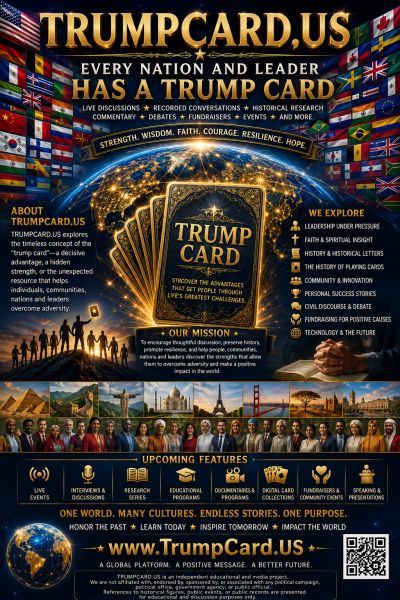
The Beginning of Card Decks... In Your Life.
Chapter 1: Ancient Cards — From Leaves and Money to the First Decks
Playing cards are not modern inventions. Their roots stretch back more than a thousand years, beginning in China and traveling through the Islamic world before reaching Europe. Understanding that long path shows how a simple idea—portable pieces of paper or pasteboard that create chance, hierarchy, and decisive advantage—became a lasting human tool.
Tang Dynasty Origins (8th–9th Century China)
The earliest clear references appear in Tang Dynasty China (618–907 CE). A late Tang text describes Princess Tongchang, daughter of Emperor Yizong, playing a “leaf game” (yezi ge or ye zi xi) with members of the Wei clan around 868 CE. Scholars debate exactly what the “leaves” were. Some argue they were literal paper cards; others suggest they were pages of a reference book used with dice. Either way, the idea of paper pieces used in social games of chance and instruction was present by the ninth century.
A looser category of early “cards” includes Tang-era wine cards used in drinking games: players drew a card and followed its instruction (drink a certain number of cups, or make someone else drink). These were simple, functional, and tied to social ritual. By the Song Dynasty (960–1279) and especially the Yuan Dynasty, paper cards were unambiguous. A 1294 legal case recorded in a Yuan compilation describes two gamblers arrested in Shandong with nine paper playing cards and the woodblocks used to print them. This is the earliest clear documentary evidence of actual playing cards.
Chinese Money-Suited Cards
The most important early form was the money-suited deck. These cards used four suits based on Chinese currency units: single coins (wen), strings of coins (suo), myriads of strings, and tens of myriads. A typical early deck had 38 cards. The suits represented different scales of value, and games involved combining or taking cards according to their rank and suit. These decks already contained the core ideas that would travel west: multiple suits, ranked cards, and the possibility that one category could override or dominate others. Scholars such as Michael Dummett have argued that both the suit system and the concept of trick-taking games likely originated in China.
The Mamluk Bridge (12th–15th Century Egypt and the Levant)
Playing cards reached the Islamic world by the 12th or 13th century, almost certainly via Silk Road and Mongol-era trade. The crucial surviving examples are Mamluk cards from Egypt. Fragments date to the late 12th or early 13th century; a nearly complete reconstructed deck (the Topkapı Palace group) comes from the 15th century. These were large, hand-painted luxury objects on pasteboard, decorated with geometric designs and calligraphy rather than human figures (consistent with Islamic artistic conventions).
A full Mamluk deck contained 52 cards in four suits: cups (or myriads), swords, coins (or daráhim), and polo sticks (or batons). Each suit had ten numbered cards and three court cards (king, deputy/viceroy, and under-deputy). This structure is already recognizably close to the modern deck. The Mamluk cards are the direct ancestors of European packs. The word naib (deputy or lieutenant) for one of the court ranks later appears in European languages as naibi or similar terms for cards themselves.
Arrival in Europe (Late 14th Century)
Cards appear suddenly in European records in the 1370s. A 1371 Catalan reference, a 1377 Swiss chronicle by Johannes of Rheinfelden, and Italian mentions of naibbe or nabbie all treat cards as a recent introduction. The most likely route was Mediterranean trade with Mamluk Egypt and the Islamic ports of the Iberian Peninsula and Italy. Early European cards were hand-painted luxury items for the wealthy. The earliest surviving European fragments include the so-called Gringonneur cards associated with King Charles VI of France around 1392–1395.
In Europe the four Mamluk suits were adapted locally: cups, swords, coins, and batons/polo sticks became the Spanish and Italian suits still used today in some regions. In France, simplified suit symbols (hearts, diamonds, clubs, spades) emerged in the late 15th century through stencil printing and became the international standard. Court cards gained human figures and names. The joker was a much later American addition. The modern 52-card deck with two jokers is the product of roughly a thousand years of cultural adaptation, printing technology, and local invention.
From Ancient Cards to the Idea of a Trump Card
The word “trump” itself is later and European, deriving from “triumph” and referring in many games to a suit or special cards that outrank all others. The underlying idea—that one category of cards can override the normal order—is already latent in the early Chinese and Mamluk systems of ranked suits and court cards. Ancient cards were never purely random; they combined chance with hierarchy, strategy, and the possibility of a decisive advantage held in reserve.
This history is the natural beginning of any discussion of “a trump card for life.” The earliest decks were tools people used to manage uncertainty, create social games, and give structure to chance. Over centuries they became standardized, mass-produced, and universal. The same principle applies to a personal trump card: it is not magic and it is not guaranteed. It is a prepared, specific advantage—skill, knowledge, composure, optionality, or character—that can override ordinary disadvantages when the moment arrives. Like the ancient cards that traveled from Tang China through Mamluk Egypt into Europe, a personal trump card is built through time, adaptation, and deliberate effort.